
In steel formwork design, the answer to "how thick should the panel plate be" does not come from experience but from fresh concrete pressure. A section chosen without knowing that pressure is either unnecessarily heavy and expensive, or it bulges in the first few pours.
Why the pressure is not hydrostatic
Water exerts pressure linearly with depth. Concrete behaves like a liquid at the moment it is placed; but as setting begins it starts to carry its own weight, and the horizontal pressure it applies to the form stops increasing beyond a certain depth. The pressure diagram therefore increases linearly at the top and then settles at a constant value.
The hydrostatic assumption (σ = γ·h) is always on the safe side, but at 3 m height it gives an unnecessary 75 kN/m²; the real value is often half of that. It means building the form twice as heavy as needed.
The DIN 18218 approach
The standard relates maximum horizontal pressure to two things:
- Pour rate
v(m/hour) — the faster the concrete rises, the less time the concrete below has to set, and the higher the pressure - Consistency class (F2…F6 / SCC) — flowable concrete exerts higher pressure
A temperature correction is added: as concrete temperature drops, setting is delayed and pressure rises. Concrete placed at 5 °C applies markedly higher pressure than the same mix at 25 °C.
The steps are:
- The characteristic maximum pressure
σ_maxis obtained from consistency class and pour rate. - The temperature correction is applied.
- The depth at which the pressure becomes constant is found from
h_s = σ_max / γ_concrete; a triangular diagram is used above that depth and a rectangular one below it. - The diagram is applied as a distributed load on the panel; panel plate, vertical stiffeners and tie rods are dimensioned for it.
- Load factors are applied and the deflection limit is checked.
Estimating the pour rate
Pour rate is not measured after the pour, it is assumed in advance and respected on site:
v = Concrete output (m³/hour) ÷ Plan area of the form (m²)
Example: a pump output of 8 m³/hour, a wall 0.25 m thick and 12 m long — plan area 3 m², so v = 2.7 m/hour.
If the calculation was made for 2 m/hour, opening the pump on site and placing at 6 m/hour loads the panel beyond its design. Pour rate is a condition of use for the formwork, not a recommendation.
Values used in panel sizing
| Input | Typical range | Effect |
|---|---|---|
| Pour rate | 1–4 m/hour | Higher rate, higher pressure |
| Concrete temperature | 5–30 °C | Lower temperature, higher pressure |
| Consistency | F3–F5, SCC | More flowable, higher pressure |
| Wall height | 2.7–6 m | No increase beyond the constant-pressure depth |
| Vibration depth | 0.5–1.5 m | Deep vibration raises pressure locally |
If self-compacting concrete (SCC) is to be used, the calculation is made separately: because SCC needs no vibration it behaves as a full liquid until setting, and hydrostatic pressure is assumed.
What we ask for in practice
When starting a formwork project we ask the client for three things:
- The consistency class of the concrete, or whether it is SCC
- The target pour rate, or the pump output together with the element section
- The season of casting / expected concrete temperature range
Selecting a panel plate before those three inputs arrive is guesswork. Where the information is not firm, we calculate for the most unfavourable combination (low temperature, high rate, flowable consistency) and build to that — the form becomes heavier, but there is no risk of bulging on site.
Common mistakes
- Widening tie spacing on site. Tie rod spacing is part of the calculation; skipping one row more than doubles the bending moment on the panel.
- Using the same calculation in cold weather. Setting is delayed in winter, so the same pour rate means higher pressure.
- Resting the vibrator against the panel. When vibration energy enters the panel directly, local pressure goes beyond the calculation.
- Transferring formwork between projects without checking the new section. The same panel carries a different load on a thicker wall.
In short
Fresh concrete pressure is the starting point of steel formwork design. A section chosen without knowing pour rate, concrete temperature and consistency is a guess. Done properly, the calculation gives a form that is both light and safe.
PRODUCT GROUPS IN THIS ARTICLE
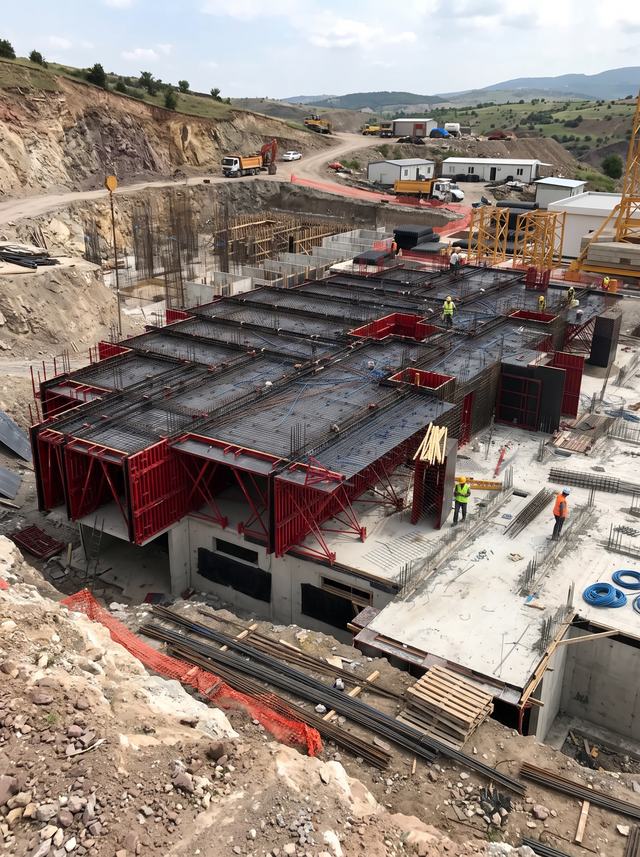
BUILDING TUNNEL FORMWORK
Half-tunnel steel formwork casting load-bearing walls and the slab in a single operation.
VIEW SHEAR PANEL MOULDSHEAR PANEL MOULD
Production mould for load-bearing and partition precast shear panels.
VIEW CIRCULAR WALL FORMWORKCIRCULAR WALL FORMWORK
Curved steel formwork for silos, water tanks and circular structural walls.
VIEWLet us work out the right formwork configuration for your project.
REQUEST A QUOTE