
In a precast plant, mould selection follows the production scenario more than the shape of the element. The same beam can be produced with three different mould types; which one is right depends on daily output, surface requirements and the crane and steam infrastructure on site.
Five inputs needed for the decision
- Daily / annual output — how many cycles the mould will run
- Element section and length — load and mould length
- Surface requirement — exposed concrete or to be rendered
- Curing method — natural, steam or covered
- Plant layout — fixed line or open yard, and crane capacity
Discussing mould type before these five are clear is premature.
Common solutions by element type
Beam moulds
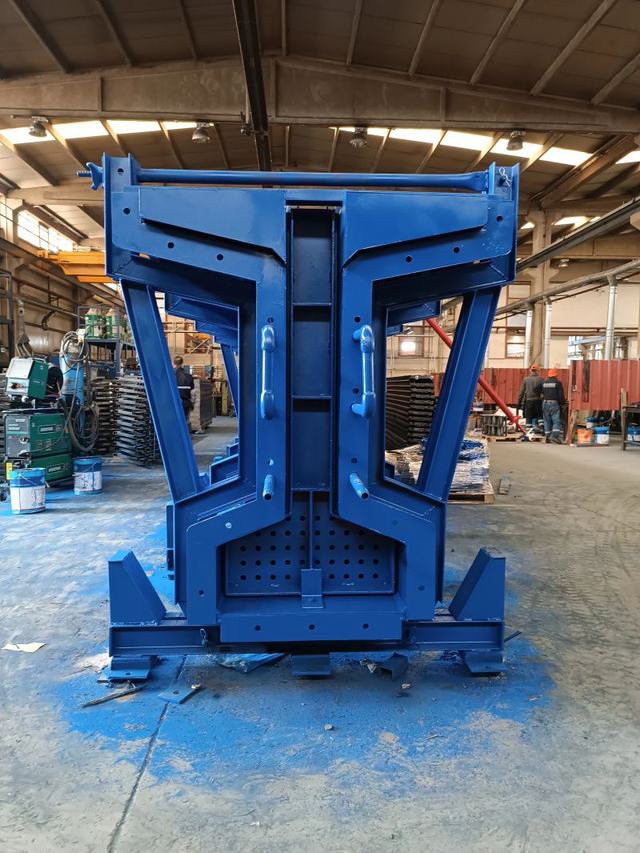
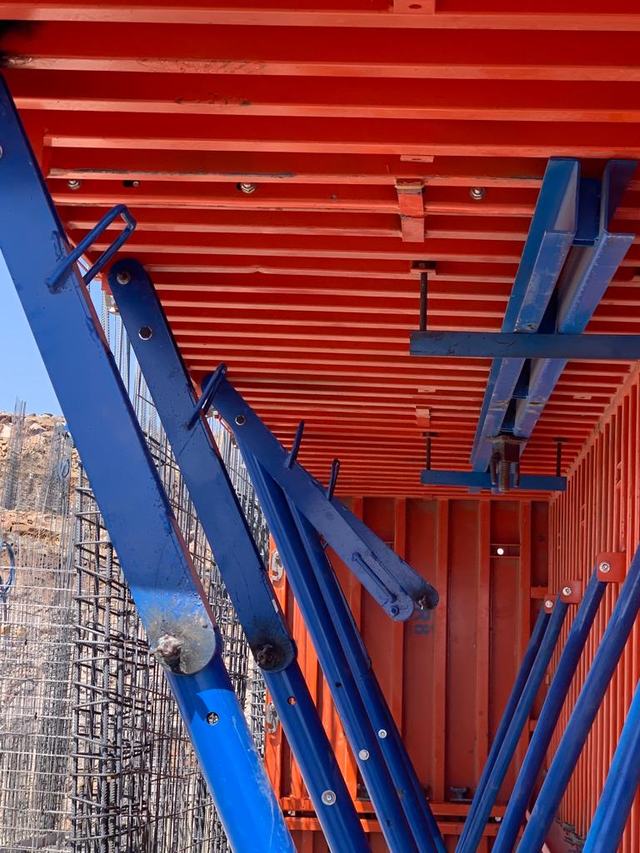
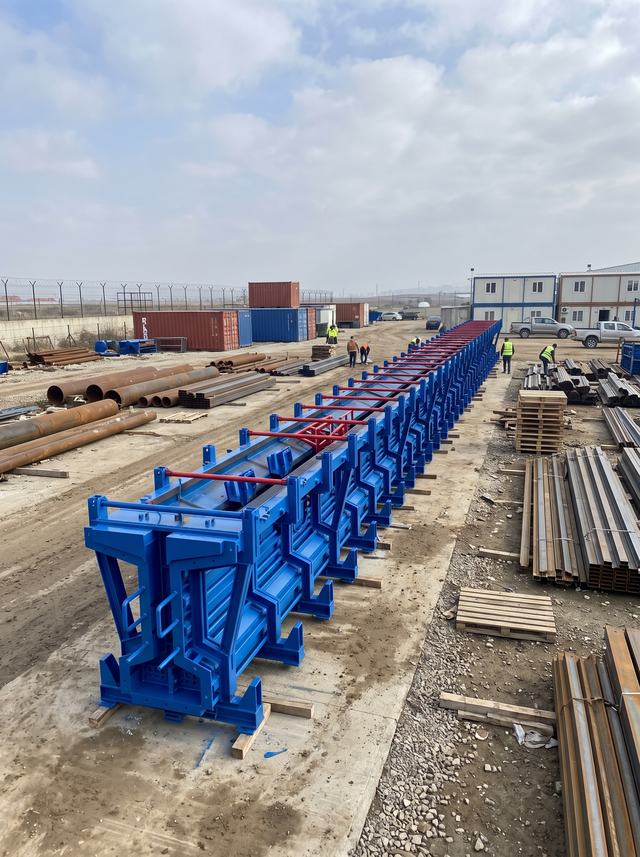
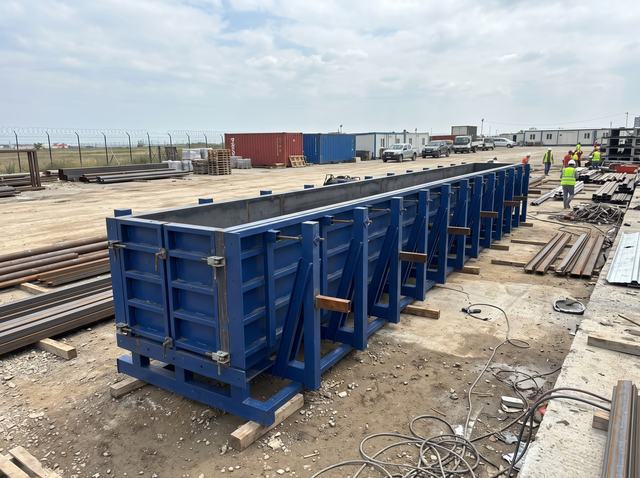
For rectangular, I, L and LT sections, a mould with hinged side panels and a fixed bed is standard. When the side panel is laid outward the element is lifted straight out by crane; the mould itself is never dismantled. Where the section varies, side panels are made extendable with filler pieces.
- I beam — mould at the bed and top flange, with an internal form creating the web void
- L beam — edge axis beam; bed projecting on one side
- LT beam — double projection; the slab seating face is held to tight tolerance in the mould
Column moulds
Columns are generally produced in a horizontal mould: three of the four faces formed, one face open. Corbel and socket details are added as removable inserts. Where corbel positions vary by project, adjustable corbel boxes are placed along the bed so one mould produces several column types.
Slab and wall panel moulds
There are two routes for flat elements:
| Tilting table | Battery mould | |
|---|---|---|
| Layout | Horizontal, large area | Vertical, small footprint |
| Area use | Takes much space | 6–12 panels in the same area |
| Surface | One face smooth | Both faces smooth |
| Curing | Heating under the table | Steam between panels — fast |
| Investment | Lower | Higher |
Where high volumes of panels smooth on both faces are produced, the battery mould is the most area-efficient solution.
Site elements
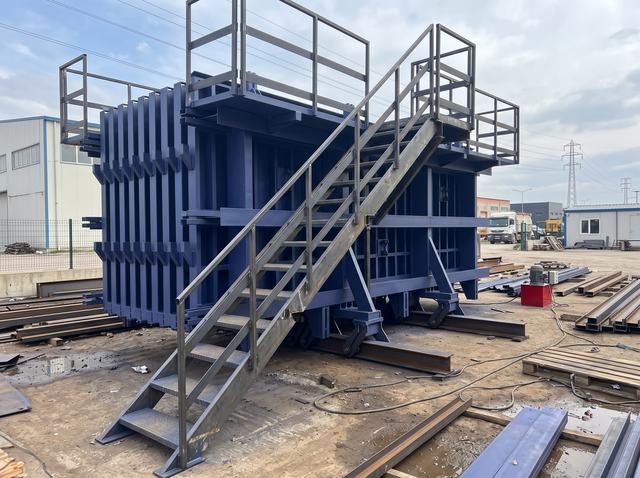
For culverts, barriers, kerbs, gratings, channels and sleepers, the decisive factor is cycle speed. These moulds typically:
- Work as an outer form plus an inner core
- Are given a slight taper (0.5°–2°) to ease stripping
- Keep lifting anchors and pick-up points fixed in the mould
Tetrapods and special geometry
For three-dimensional, non-symmetrical elements the mould is designed in segments, each released by its own latch. The critical point is that segments seat in exactly the same position every cycle; otherwise element dimensions drift.
Repetitions and mould economics
There are roughly three bands:
- Below 500 cycles — light steel sections, simple stripping, moderate cost
- 500–2,000 cycles — reinforced panels, thickened wear faces, serviceable hinges and latches
- Above 2,000 cycles — replaceable contact face, high-strength steel, spare parts list
When unit cost over the mould's life is calculated, what matters is not the purchase price but the cost per cycle. The saving from a cheaper mould disappears when it starts marking the surface at the 300th pour.
What is done in the mould for surface quality
- Flatness of the contact plate — panels are straightened after welding to counter weld shrinkage
- Tightness of joints — concrete leakage marks the surface and builds up in the mould
- Corner chamfers and radii — a sharp corner tires the mould and makes the element brittle
- Vibrator mounting points — mounted vibrator positions are determined by calculation, not welded at random
Mould to suit the plant, or plant to suit the mould
In a new plant the correct order is: product first, then the line, then the mould. Once element quantity and length are known the line layout follows; once the line layout is known, where the mould sits, where the crane lifts from and where the steam line arrives are all known. A mould designed with that information wastes neither space nor time in the plant.
In short
In precast mould selection, the element section is only the starting point. Once output, surface requirements and plant layout are known, the right mould type becomes evident. If that information is not yet in hand, the first step is not the mould but working out the production scenario.
PRODUCT GROUPS IN THIS ARTICLE
Let us work out the right formwork configuration for your project.
REQUEST A QUOTE